
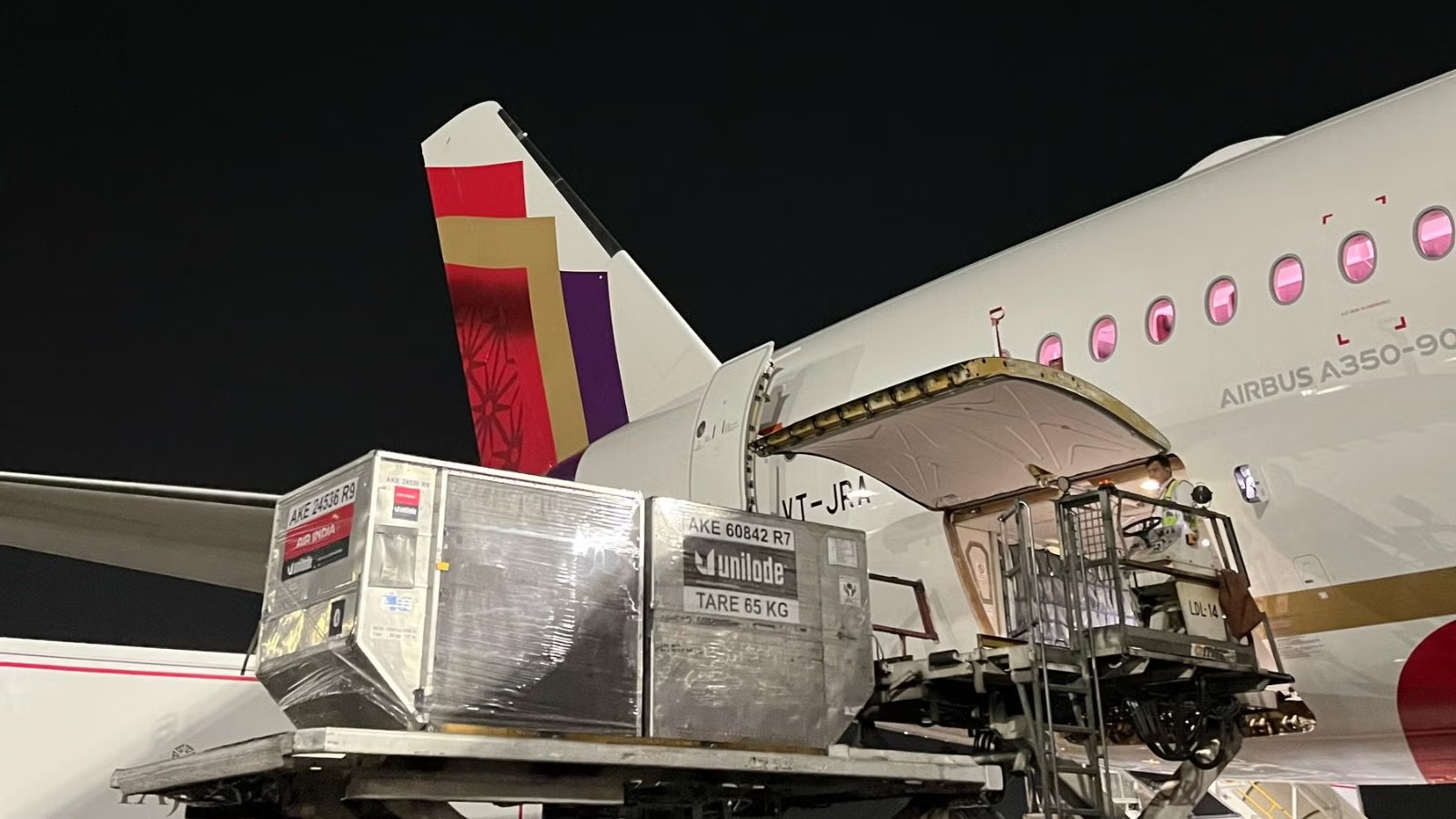
India’s express logistics and courier sector has evolved from a niche document-delivery service into a critical backbone for exports, cross-border e-commerce, manufacturing supply chains and MSME participation in global trade. Today, the sector has reached an estimated market size of around USD 9 billion in FY25 and is projected to more than double to nearly USD 22 billion by FY30, with the potential to generate up to 7 million direct and indirect jobs. This scale underscores the urgency of aligning regulation with operational and technological realities.
Modernising Courier Regulations: As the Union Budget 2026 approaches, there is a strong case for modernising courier regulations in a manner that strengthens, rather than dilutes, Customs oversight. The objective is not deregulation, but alignment with India’s fully digital, risk-managed Customs ecosystem.
The Courier Imports and Exports Regulations, 2010 were introduced to move courier processing from manual workflows to an electronic environment. Over the years, this objective has been realised through the Electronic Courier Clearance System (ECCS), supported by national risk management systems, digital payments and post-clearance audits. However, several restrictions carried forward from an earlier regulatory era now constraints trade without adding proportionate risk mitigation.
One such constraint is the ₹10 lakh value cap on courier exports. This cap does not apply to air cargo or India Post and has no equivalent in major exporting economies. Express logistics networks operate on time-definite, fully tracked and digitally audited platforms. Retaining a value cap based on legacy risk perceptions restricts exporters’ ability to fulfil high-value e-commerce and design-led export orders, forcing them into slower channels and increasing transaction costs.
India’s ambitions in pharmaceuticals, biotechnology, electronics and agri-trade also depend on enabling the import of perishables and regulated goods through express mode. Ambiguity around the definition of perishables and legacy exclusions on goods requiring testing have led to subjective interpretation, avoidable detentions and increased dwell time. For temperature-sensitive medical samples, biological materials and specialised food products, such delays can undermine product integrity. With electronic NOCs, Partner Government Agency integration and complete audit trails now available, targeted and risk-based controls can safely replace blanket exclusions.
The case for advance filing of courier Bills of Entry basis House Airway Bills (HAWBs) is equally compelling. Express logistics operates on a door-to-door model using Courier Air Waybills with dynamic routing through regional hubs. Requiring MAWB and flight details at the advance filing stage undermines pre-arrival processing. Allowing filing based on courier AWBs, with flight details updated at the manifest stage, will enable earlier RMS decisions, faster out-of-charge and reduced dwell time, fully aligned with existing ICES practices.
Operational efficiency is also affected by uncleared courier imports that remain in India for extended periods due to KYC issues or non-responsive consignees. Reducing the Section 48 timeline for courier imports to 15 days and enabling return-to-origin for non-interdicted shipments will decongest terminals, reduce safety and intellectual property risks, and eliminate unnecessary storage and destruction.
From a compliance standpoint, introducing a Voluntary Disclosure framework under the courier regulations can strengthen cooperative compliance. Express operators perform system-driven statutory functions on behalf of trade and Customs and are often best placed to identify documentation gaps or discrepancies. Providing protection for bona fide disclosures will improve intelligence quality and early interdiction while preserving accountability.
It is also important to rationalise licence suspension and cancellation provisions. While firm action is essential in cases of systemic fraud or national security risk, suspension as a first response to operational lapses can disrupt international supply chains and undermine India’s credibility as a reliable trading partner. Proportionate enforcement better balances compliance with continuity.
Real-Time Exchange: Finally, India must move towards a real time data exchange between various government systems to include ECCS, ICEGATE, ICES, DGFT etc. Fragmented systems and legacy valuation formats create mismatches and post-clearance disputes. Also, it is important that the SEZ & EOU courier shipments are enabled for clearances through ECCS as it will support for India’s export-oriented manufacturing ecosystem. Harmonised data standards and fully digital workflows will future-proof India’s express trade architecture.
These reforms do not weaken Customs control. They strengthen it by leveraging digital data, national risk management and audit trails. Union Budget 2026 offers a timely opportunity to align courier regulations with the scale, ambition and growth trajectory of India’s express logistics sector.

Mr Vijay Kumar is CEO, Express Industry Council of India

